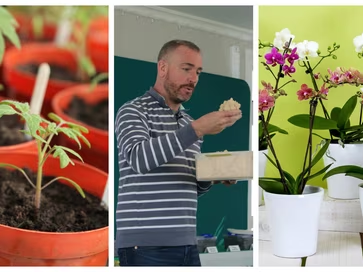
Wood Fiber Substrates: Current Developments and Future Potential
Brian Jackson is a Professor in the Department of Horticultural Science and Director of the Horticultural Substrates Laboratory at North Carolina State University. He is a world-leading expert and has researched soilless growing media for horticultural crop production since 2003, with a particular focus on substrate physical properties and peat alternatives.
Here, Brian gives an update on the global growth of engineered wood fiber, what is driving grower adoption, and its future potential as a component of horticultural growing media.
Current Global Developments
Since the conception of engineered wood fiber substrates in Europe in the late 1970’s, the number of growing media suppliers who now offer wood products has increased exponentially in the past 5-7 years. Many have been producing wood fiber for a long time, while others have more recently decided to invest in fiber production facilities themselves instead of procuring it from other suppliers.
Some European substrate suppliers have multiple wood fiber units at one or more of their production locations to reduce transport costs and take advantage of regionally available forest/biomass resources. Additionally, companies outside of Europe and North America have also began producing wood fiber for several years, namely in Australia and New Zealand.

Professor Jackson - visiting Daltons Christchurch

Growing Global Investment in Wood Fiber
As a testament to the popularity and proven potential of wood fiber as a stable growing media component, in 2017 there were fewer than 10 wood fiber processing units/machines around the world – today (2026) there are over 125.
With each processing machine costing in the range of ~1.2 – 5.0 million (USD), the investment being made by growing media manufacturers is not insignificant. If the pace and scale of global wood fiber development and adoption in the past five years continues, it is reasonable to conclude that the future of growing media and soilless cultivation is on the cusp of a transition that the global horticulture industry hasn’t experienced since the transition to peat over a half century ago.

Wood Fibre as a Growing Media or Media Component
What is Driving Grower Adoption?
There can be many reasons why growers may decide to trail or fully adopt new substrates including
- new products may better align with sustainability goals,
- the desire to support domestic product use,
- more reliable product availability and supply year-to-year,
- enhanced crop performance (sterile materials, improved substrate biology, automation efficiency, etc.), or
- cost of products and production inputs (water, fertilizer, crop shrinkage, retail shelf life).
Some decisions to switch to new growing media products may not be voluntary if there are supply shortages, transportation disruptions of imported goods, or prohibitive cost increases of traditionally used materials.
The Search for Reliable, Regionally Produced Materials
The fluctuation in substrate supply (particularly imported products) and cost from year to year in conjunction with some peat reduction efforts around the world, has brought global scientists and growing media manufacturers together, now more than ever, to collectively assess the current and future limitations on growing media supply and availability and to identify the best options for sourcing regionally/domestically produced materials. The most promising material of significant abundance for many regions of the world is forest products – wood and bark.
Engineering Wood for Growing Media
Similar to a blank canvas ready and waiting to be transformed into a work of art by an artist, wood can be specifically and strategically engineered in many ways using numerous processing techniques to create unique, consistent, and reproducible products for use in growing media. The end product is a result of intentional manipulation to create substrate components suitable for a broad variety of purposes.
Performance and Crop Applications
Commercial wood fiber products on the market today have now been thoroughly investigated by research scientists and trialed or fully adopted by growers around the world. Wood products are (or can be) available in a variety of sizes and densities suitable for a range of uses – from propagation, short-term (<4 month), medium-term (4 – 8 months), or long-term (1+ years) crop production.
Commercially produced wood products have a naturally high degree of physical stability (compared to peat or bark), have low inherent pH (~5 – 6.0) which is easily adjustable and a very low electrical conductivity (EC) or nutrient sources.
Most commercial products are relatively sterile – free from the natural chemicals in fresh wood that can be phytotoxic to plants, thanks to the high-tech processing methods used to create the wood fiber which exposes the wood to high heat, pressure, and friction. This allows for wood fiber to be used immediately after production with no need of aging or composting the material. Wood products are lighter in weight (density) than peat, bark, pumice, etc. and therefore facilitate cheaper transit costs (more product on a truck).


Root Growth and Future Potential
One of the most noted observations by growers and researchers regarding the inclusion of wood fiber in substrates is the enhanced root growth and development (compared to other common substrates) of numerous crops ranging from propagation all the way to full production. Growing evidence also suggests that certain wood fiber products can be successfully used as a 100% substrate for the production of many hydronic and greenhouse-grown crops – with additional evidence that repeated (re-cropping) production of some greenhouse vegetables is possible.
As R&D into wood fiber continues to further improve nutrient tie-up (Nitrogen use) and biostabilty (physically and chemically) – its use and use rate is likely to increase for growers producing many different horticultural crops.